Friday, October 4, 2013

Requirement or essentials of a valid meeting or, necessary conditions of a valid meeting: There must be some requisites in order to validate the meeting. The necessary pare-conditions of a valid meeting are stated below:


  1. Right convening authority: A valid meeting must be convened by the proper authority otherwise it wills loss its validity. Company’s secretary is the proper authority to call a formal meeting.


  2. Proper notice: Duty signed notice must be submitted to members before meeting. The place of meeting, time and date must be stated on the notice.


  3. Proper publicity of agenda: Every member of the meeting should be properly informed of the agenda.


  4. Legal purposes: Every meeting must have a legal purpose. Any meeting should be properly informed of the agenda.


  5. Requisite quorum: For valid meeting requisite quorum is necessary. The meeting should not be stared until the requisite members of member s are resent.


  6. Presence of right persons: Only legal members can present in the meeting. If there is an unauthorized person in the meeting, the meeting will lose its validity.


  7. Proper presiding officer: The chairman of a valid meeting must be a proper person.


  8. Conducting meeting according to the agenda: A valid meeting must be conducted according to the agenda. No decision will get validity, if it is not related to the agenda.


Role or function or duties of chairmen of a meeting: In all types of meetings, you have the following responsibilities as a presiding officer.


  • Arranging the time and place

  • Preparing and serving an agenda.

  • Calling the meeting to order on time

  • Making clear the purpose of the meeting

  • Keeping the discussion on course

  • Controlling over enthusiastic members

  • Electing contributions from each member

  • Creating a good atmosphere

  • Summarizing the discussion form time to time

  • Working to end the meeting on schedule

  • Thanking to the members


Secretarial work relating to statutory meeting


1. Functions before the meeting:


  • Maintaining time for statutory meeting,

  • Preparing statutory statement or report,

  • Drafting a notice for the meeting,

  • Collecting the auditor’s certificate,

  • Selection the place of the meeting,

  • Preparing agenda of the meeting,

  • Listing the name of members who will attend the meeting,

  • Calling on board of directors meeting,

  • Preparing final notice of the meeting.

  • Serving the notice to the concerned members.


2. Functions at the meeting:


  • Determining the quorum of the meeting,

  • Stating or reading the agenda,

  • Supply of the necessary explanations,

  • Giving the explanations,

  • Writing the rough minutes


3. Functions after the meeting:


  • Preparing final minutes and resolutions,

  • Submitting the statutory report


What is notice?|Specimen of notice

Meaning of notice: A notice is a written or an oral statement that contains the particulars of holding a meeting. When a circular is served among the members of the meeting to attend the meeting, it is called a notice. It is letter of invitation that carries the request to the members to attend a meeting. A notice includes time, place, date and agenda of a meeting. The notice should be sent by the proper authority in due time so that the members can attend the meeting in time.


So, notice is formal written or formal information, notification or warning about a fact or an invitation to the concerned person for attending the meeting.


Essential elements or factors of a valid notice: The essentials or elements or factors of a valid nonce are given below:


  1. Signature: The notice must be signed by the proper authority. Only the legal authority should serve the notice.


  2. Proper time: The notice must be served in proper time. It should be circulated according to the rules and regulations of the company or the organization.


  3. Time date and place: The time, date and place of the meeting must be stated in the notice.


  4. Unconditional: There must be no condition or complexity in the notice about attending meeting. Always a notice is unconditional.


  5. Agenda: Agenda means topics to be discussed in a meeting. A valid notice should contain the agenda of the meeting.


  6. Conciseness: The notice must be short in size. It should be clear, simple and easy.


  7. Proper persons: Notice should be served to the proper persons who are entitled to attend the meeting.


  8. Enclosure: An explanatory statement should be sent with the notice.


Notice-of-a-statutory-meeti


Specimen of notice:


  1. Notice of statutory meeting of a company


Eastern Jute Mails Ltd.

102, New York C/A

New York-1000

Date: March 20, 2013


NOTICE FOR STATUTORY MEETING


Notice is hereby given that the statutory meeting of the company will be held on March 30, 2012 at 12 p.m. in the registered office of the company according to the section ……………. Of company Act. 1994.


Concerned shareholders are requested to attend the meeting.

Mr. John


Secretary

On behalf of the board

Of directors.


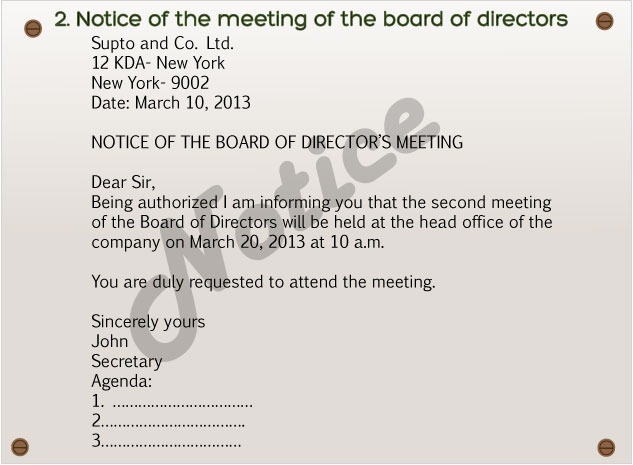
  1. 2. Notice of the meeting of the board of directors


Supto and Co. Ltd.

12 KDA- New York

New York- 9002

Date: March 10, 2013


NOTICE OF THE BOARD OF DIRECTOR’S MEETING


Dear Sir,

Being authorized I am informing you that the second meeting of the Board of Directors will be held at the head office of the company on March 20, 2013 at 10 a.m.


You are duly requested to attend the meeting.


Sincerely yours

John

Secretary

Agenda:

1. ……………………………

2…………………………….

3……………………………


What is notice?|Specimen of notice

Thursday, October 3, 2013

What is verbal communication and non-verbal communication?

What is verbal communication?
Meaning of verbal communication: When messages or information is exchanged or communicated through words is called verbal communication. Verbal communication may be two types: written and oral communication. Verbal communication takes place through face-to-face conversations, group discussions, counseling, interview, radio, television, calls, memos, letters, reports, notes, email etc. some definitions of verbal communications are as follows:


According to Bovee and others: Verbal communication is the expression of information through language which is composed of words and grammar.”


According to Penrose and others, “Verbal communication consists of sharing thoughts thought the meaning of words.”


So, verbal communication is the process of exchanged of information or message between two or more persons through written or oral words.


What is non-verbal communication?
Meaning of non-verbal communication: When messages or information is exchanged or communicated without using any spoken or written word is known as nonverbal communication. Non-verbal communication (NVC) is usually understood as the process of communication through sending and receiving wordless messages.


Non-verbal communication is a powerful arsenal in the face-to-face communication encounters, expressed consciously in the presence of others and perceived either consciously or unconsciously. Much of non-verbal communication is unintentional people are not even aware that they are sending messages. Non-verbal communication takes place though gestures, facial expressions, eye contact, physical proximity, touching etc. some important definitions of non-verbal communication are as follows:


According to L. C. Bove and others, “Non-verbal communication is communication that takes place through non-verbal cues: through such form of non-verbal communication as gesture, eye contact, facial expression, clothing and space; and through the non-verbal vocal communication known as Para-language.”


According to Lesikar and Pettit, “Nonverbal communication means all communication that occurs without words (body movements, space, time, touch, voice patterns, color, layout, design of surroundings.)”


According to Himstreet and Baty, “Non-verbal communication includes any communication occurring without the use of words.”


So, non-verbal communication is the exchanged of information or message between two or more persons through gestures, facial expressions eye contact, proximity, touching etc. and without using any spoken or written word.


Characteristics of non-verbal communication

Non-verbal communication is any information that is communicated without using words. The important characteristics of non-verbal communication are as follows:


  1. No use of words: Non-verbal communication is a communication without words or language like oral or written communication. It uses gestures, facial expressions, eye contact, physical proximity, touching etc. for communicating with others.


  2. Culturally determined: Non-verbal communication is learnt in childhood, passed on to you by your parents and others with whom you associate. Through this process of growing up in a particular society, you adopt the taints and mannerisms of your cultural group.


  3. Different meaning: Non-verbal symbols can many meanings. Cross-culture aspects give various meanings to same expression in respect of non-verbal communication.


  4. Vague and imprecise: Non-verbal communication is quite vague and imprecise. Since in this communication there is no use of words or language which expresses clear meaning to the receiver.


  5. May conflict with verbal message: Non-verbal communication is so deeply rooted, so unconscious, that you can express a verbal message and then directly contradict it with a nonverbal message.


  6. Largely unconscious: Non-verbal communication is unconscious in the sense that it is usually not planned nor rehearsed. It comes almost instantaneously.


  7. Shows feelings and attitudes: Facial expressions, gestures, body movements, the way you use your eyes – all communicate your feelings and emotions to others.


  8. Informality: Non verbal communication does not follow any rules, formality or structure like other communication. Most of the cases people unconsciously and habitually engaged in non-verbal communication by moving the various parts of the body.


Advantages and disadvantages of non-verbal communication

Advantages or functions or importance of non-verbal communication:There is a proverb “Actions speak louder than words.” In essence, this underscores the importance of non-verbal communication. Non-verbal communication is especially significant in intercultural situations. Researches in communication suggest that many more feelings and intentions are sent and received non-verbally than verbally. Meharabian and wiener following suggested that only 7 % of message is sent through words, with remaining 93% sent non-verbal expressions (depending on author, verbal part goes up to 35%). It has multiple advantages or functions:


  1. Complementary: Non-verbal cues complement a verbal message by adding to its meaning. You can pat someone you offended at the back as you say sorry to him or her.


  2. Easy presentation: Information can be easily presented in non-verbal communication through using visual, audio-visual and silent means of non-verbal communication.


  3. Substituting: Non-verbal message may substitute for the verbal message especially if it is blocked by noise, interruption, long distance etc. for example: gestures-finger to lips to indicate need for quite, facial expressions- a nod instead of a yes.


  4. Accenting: Often used to accent a verbal message. Verbal tone indicates the actual meaning of the specific words.


  5. Repeat: Used to repeat the verbal message (e.g. point in a direction while stating directions.)


  6. Help to illiterate people: This type of communication use gestures, facial expressions, eye contact, proximity, touching etc. and without using any spoken or written word. So, it is very much helpful for illiterate people.


  7. Help to handicapped people: Non-verbal cues of communication greatly help in handicapped people especially to deaf people. Deaf people are exchange message through the movements of hands, fingers, eye ball etc.


  8. Attractive presentation: Non-verbal communication is based on visual, picture, graph, sign etc. that can be seen very much attractive.


  9. Reducing wastage of time: The message of non-verbal communication reached the receiver very fast. For this reason it reduces the wastage of valuable time of the communicator.


  10. Quick expression of message: Non-verbal cues of communication like sign and symbol can also communicate some messages very quickly than written or oral messages.


Disadvantages or limitations of non-verbal communication: Despite of advantages of non-verbal communication, it is not free from its limitations or disadvantages which are:


  1. Vague and imprecise: Non-verbal communication is quite vague and imprecise. Since in this communication there is no use of words or language which expresses clear meaning to the receiver. No dictionary can accurately classify them. Their meaning varies not only by culture and context but by degree of intension.


  2. Continuous: It is possible to stop talking in verbal communication, but it is generally not possible to stop nonverbal cues. Also, spoken language has a structure that makes it easier to tell when a subject has changed, for instance or to analyze its grammar. Nonverbal does not lend itself to this kind of analysis.


  3. Multi-channel: while watching someone’s eyes, you may miss something significant in a hand gesture. Everything is happening at once and therefore it may be confusing to try to keep up with everything. Most of us simply do not do so, at least not consciously.


  4. Culture-bound: Non-verbal communication is learnt in childhood, passed on to you by your parents and others with whom you associate. A few other gestures seem to be universal. Evidence suggests that humans of all cultures smile when happy and frown when unhappy. However, most nonverbal symbols seem to be even further disconnected from any “essential meaning” than verbal symbols. Gestures seen as positive in one culture (Like the thumbs-up gesture in the USA) may be seen as obscene in another culture.


  5. Long conversations are not possible: In non-verbal communication, long conversation and necessary explanations are not possible. No party can discuss the particular issues of the messages.


  6. Difficult to understand: Difficult to understand and requires a lot of repetitions in non-verbal communication. Since it uses gestures, facial expressions eye contact, touch etc. for communicating with others which may not be understandable for the simple and foolish people.


  7. Not everybody prefers: Everybody not prefers to communicate through non-verbal communication with others. Sometimes it cannot create an impression upon people or listeners. It is less influential and cannot be used everywhere. It is cannot be used as a public tool for communication.


  8. Lack of formality: Non-verbal communication does not follow any rules, formality or structure like other communication. Most of the cases people unconsciously and habitually engaged in non-verbal communication by moving the various parts of the body.


  9. Costly: In some cases non-verbal communication involves huge cost. For example, neon sign, power point presentation, cinema etc are very much costly compared to others form of communication.


  10. Distortion of information: Since it uses gestures, facial expressions, eye contact, touch, sign, sound, paralanguage etc. for communicating with others, there is a great possibility in distortion of information in non-verbal communication.


Wednesday, October 2, 2013

Medias or ways or forms of visual communication

Medias or ways or forms of visual communication: When communication takes place by means of any visual aid, it is known as visual communication. Such as facial expression, gesture, eye contact, signals, map, chart, poster, and slide, sign etc.


1. Body language: Some parts of our body can express many indications without any sound. Message can be transmitted with the help of our body movements which is called body language. Body language is a form of visual communication, which consists of posture, gestures, facial expressions, eye movements etc.


  • Facial expression: A facial expression is one or more motions or positions of the muscles in the skin of face. Facial expressions for happiness, sadness, anger and fear are similar throughout the world. Proverb says, “Face is the index of mind.”


  • Gestures: Gestures refers to visible bodily actions communicate particular messages which include movement of the hands, face, eyes, head or other parts of the body.


  • Posture: Posture indicates the position in which we hold the body when standing or sitting. It can help to communicate visually.


  • Appearance and dress: Our clothes and dresses provide a good visual signal to our interest, age, personality, taste and sex. Our choice of color, clothing, hairstyles and other factors affecting appearance are also considered a means of visual communication. Research on color psychology has demonstrated that different colors can evoke different moods.


  • Touch: Touch is culturally determined; but each culture has a clear concept of what parts of the body one may not touch. Basic message of touch is to affect or control-protect, support and disapprove [(i.e. hug, kiss, hit, kick)].


2. Space or proximity: People often refer to their need for “Personal space”, which is also an important type of visual communication. If someone you don’t know stands too close or touches too often, you will probably begin to feel uncomfortable.


3. Distance: Distance is also an important type of visual communication tool. The physical distance between the people expresses the degree or level of intimacy, acceptance and comfort.


4. Visual symbols: Visual symbols are also used from long ago. For example, pigeon, tiger and white flag are used as the symbol of peace, brave and alliance respectively.


5. Signal: Signal is use in various situations as the tool of visual communication.


6. Table, chart, diagram etc: Table, chart, diagram etc. are used in data presentation.


Presentation methods of visual communication: There are many ways through which information and message can be presented. If you want to ensure the effectiveness of the presentation, you should select the most appropriate way. Some of the ways of presenting information are:

Tabulation, bar charts, line graph, pie charts, pictograms, maps, diagrams, cartograms, flow charts, visual planning boards, commuter graphics, Gantt charts etc.


Monday, April 8, 2013

What is Internal Communication? | Characteristics of Internal Communication

Internal communication is a network of information flow system that bids the organization together in relational bondage. Internal communication refers to the internal participants of an organization. The main purpose of internal communication is to ensure smooth functioning of the organizational activates. Internal communication may be two types: Vertical and horizontal communication. Some important definitions of internal communication are as follows:


According to Rajendra pal and Korlahalli, “Internal communication consists of transmitting information within the organization.


According to Lesiker and Pettit, “Internal communication consists of the structured communication within the organization that directly relates to achieving the organization’s work goal.”


According to Bovee and others, “Internal communication is the exchange of message among organizational members.”


According to S. P. Arora, “Information exchanged among executives, officials and employees of a same organization is known as internal communication.”


So, internal communication is the process of exchanging information among the people of different level or internal participants within the same organization.


Features or factors or characteristics of internal communication


Internal communication should be such that it must be helpful to increase the efficiency of the organization. So, the following factor or features should be considered in respect of internal communication:


  1. Clarity: Clarity means getting the meaning of messages accurately form the head of the sender into head of the receiver. Internal communication must be clear in meaning so that the receiver of the information can understand the subject matter of the information.


  2. Simplicity and economy: The method or media and language of internal communication must be simple and less expensive. So, the sender should choose the best method to communicate internally.


  3. Integrity: The integrity of the organization must be followed at the time of internal communication. It should be made through proper channel as required by organizational structure.


  4. Attention: The receiver should give attention to the information received as quickly as possible. Such communication must draw attention of the respective employees.

  5. Avoidance of unnecessary information: The information of internal communication must be concise. It should not be loaded with unnecessary information.


  6. Informal means: Generally internal communication follows the formal rules to exchange information. Sometimes informal organization helps to make the internal communication effective.


  7. Others: The information of it must be goal oriented, uniformity must be kept, and it must be helpful to external communication, avoiding information overload, mutual understanding and trust.


Nature of internal communication


Some important natures of internal communication are as follows:


  1. Direction: There are some special directions of internal communication which are: (a) Downward (high superior to subordinates) (b) Upward (subordinates to superiors) (c) Horizontal (officials to officials of same rank).


  2. Formality: Internal communication follows proper formalities as well as informal channels.


  3. Specific purpose: The purpose of internal communication is to ensure effective and efficient management as well as smooth operations of the concern.


  4. Frequency: One of the important features of internal communication is frequency of occurrence. It is associated with same day-to-day operations. The nature of information of internal communication is almost same in respect of every day activities.


  5. Scope: The scope of internal communication is limited. Because, internal communication cannot take the form of mass communication as it is confined within the same organization.


What is Internal Communication? | Characteristics of Internal Communication

Sunday, April 7, 2013

Advantages of Internal Communication

Importance or advantages of internal communication: Internal communication is the life blood of any organization. Both internal and external communication is equally important to control the day to day operations of an organization. The importance of internal communication can be stated as follows:


  1. Coordination: To achieve to organizational goals, co-ordination among the activities of various departments is a must. An organization can’t run smoothly without proper co-ordination. Through internal communication it is possible to co-ordinate the works among departments of an organization.


  2. Control: The last and the most important function of management are controlling. Due to effective internal communication such control is possible.


  3. MotivationMethods of Internal Communication helps to motivate the employees of an organization. Internal communication provides good relationship among high officials and subordinates. Thorough effective internal communication employees come in contract with one another which acts as a motivating factor.


  4. Source of information: Competitive information is necessary to survive in the market economy. Only proper communication can supply such kind of information to the right person at the right time.


  5. Develop the managerial efficiency: To run the business effectively and efficiently a manager must have the proper knowledge regarding the resources of the organization. The internal communication can provide such knowledge.


  6. Job satisfaction: Job satisfaction has a great positive impact on job performance. If there is a sound internal communication system, the employees will be inspired and job satisfaction will also be kept.


  7. Run the business: To ensure the smooth operation of routine activities of an organization proper internal communication is essential.


  8. Proper supervision: If there is lack of downward and upward internal communication then the management or the supervisors failed to understand the problems of the employees. As a result proper supervision cannot be exercised.


  9. Low turnover: In presence of proper internal communication labor turnover rate reduces considerably.

  10.  Mutual trust: For the smooth functioning of an organization and for higher productivity there must be mutual trust between management and employees successful internal communication can ensure mutual trust.


  11. Motivation of employees: To provide proper motivational measures management need to have a clear view regarding the attitude of the employees. Without continuous internal communication proper motivation cannot be provided.


  12. Facilitate decision making: Participation of the employees in the decision making process not only increase the quality of decision but also ensure the better implementation of decision.


  13. Others: Besides the above importance, the following benefits may be enjoyed from internal communication: (a) Exchange of necessary ideas, news and views. (b) Development of communicative skill of employees. (c) Maintenance of link between departments and branches. (d) Increasing of employee efficiency. (e) Development of employee morale etc.


Advantages of Internal Communication